

Not every car should be insured the same way
A Ferrari, a McLaren, a Lamborghini, a Koenigsegg — each has its own repair network, its own parts costs, its own market for value, and its own set of owners who use them completely differently from one another. We write agreed-value policies built around the specific car in front of us, not a generic "exotic car" rate class.
Browse by make
We're building out a dedicated page for every marque we work with. Start with the one that matches your car — the rest are on the way.

Aston Martin
From the DB5 and DB9 through the Vanquish, and today's DB12, Vantage, DBX707, and Valkyrie.
Click to learn more →_Azure_1X7A6807.jpg)
Bentley
From the Turbo R and Arnage era through today's Continental GT, Flying Spur, and Bentayga, plus Mulliner Coachbuilt one-offs.
Click to learn more →
Bugatti
From the EB110 and Veyron era through today's Tourbillon, W16 Mistral, and Bolide, plus one-offs like La Voiture Noire.
Click to learn more →.jpg)
Ferrari
From the 250 GTO and Daytona era through the F40, F50, Enzo, LaFerrari, and today's lineup.
Click to learn more →.jpg)
Koenigsegg
From the original CC8S through the Agera era, Regera, and today's Jesko, Gemera, and CC850.
Click to learn more →
Lamborghini
From the Miura and Countach era through the Aventador, Huracán, and today's Revuelto, Temerario, and Urus S.
Click to learn more →
Lotus
From the Elan, Esprit, Elise, Exige, and Evora era through today's Emira, Eletre, Emeya, and Evija.
Click to learn more →
Maserati
From the Ghibli and Bora era through the MC12, and today's MC20, GranTurismo, and Grecale.
Click to learn more →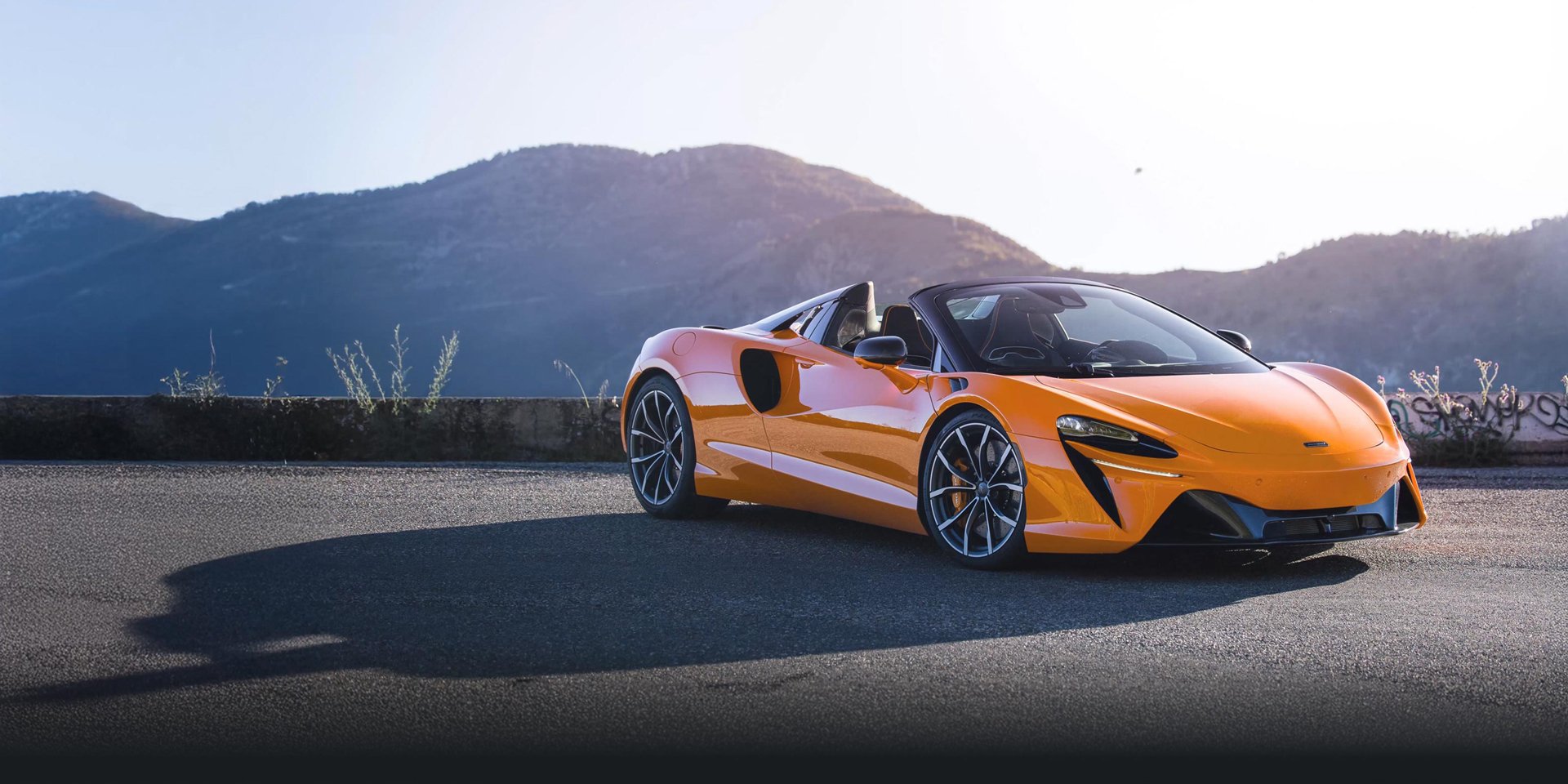
McLaren
Artura, 750S, GTS, P1, Speedtail, F1, and legacy models.
Click to learn more →
Pagani
From the original Zonda through the Huayra and today's Utopia, plus Grandi Complicazioni one-offs like the Huayra Codalunga.
Click to learn more →_1X7A7164.jpg)
Porsche
Air-cooled classics, halo cars like the 959 and Carrera GT, and today's GT3 RS, Turbo S, Cayenne, and Taycan.
Click to learn more →
Rimac
From the record-setting Concept One and Concept S through today's Nevera and track-focused Nevera R.
Click to learn more →
Rolls-Royce
From the Silver Cloud and Silver Shadow era through today's Phantom, Ghost, Cullinan, and Spectre.
Click to learn more →
TVR
The Griffith, Chimaera, Cerbera, Tuscan, and Sagaris — genuinely low-production British sports cars.
Click to learn more →
W Motors
The Lykan HyperSport and Fenyr SuperSport — among the rarest hypercars ever built.
Click to learn more →Don't see your marque? Ask us — we cover a wide range beyond what's listed here.
Not every high-performance car comes from an exotic-only marque
Mercedes-AMG, BMW M, and Lexus F build genuinely collector-grade and high-performance vehicles inside otherwise mainstream lineups. These pages focus specifically on the performance and collector-grade models — AMG, M, F — not the everyday trims from the same brand, which fall under standard auto coverage. Looking for Ford or Chevrolet's performance divisions? They're covered in our American Super & Hypercars section below.
.jpg)
BMW M
From the original M1 and E30 M3 through today's M2, M3, M4, M5, M8, and XM.
Click to learn more →
Lexus F
A complete, closed lineup — IS F, LFA, GS F, and RC F — with the F badge now fully discontinued as of late 2025.
Click to learn more →
Mercedes-AMG
From the 190E 2.5-16 Evolution and SLS AMG through today's C63, E63, G63, AMG GT, and the AMG ONE hypercar.
Click to learn more →That's the current lineup of mainstream-brand performance divisions we cover — ask us about others.
A distinct, fast-growing category of its own
From low-volume Texas and California hypercar builders to Detroit's own factory-built four-digit-horsepower muscle cars, American performance manufacturing has grown into a category that deserves its own home rather than getting split across "exotic" and "mainstream." This covers everything from a hand-built, 100-unit Rezvani to a Ford or Chevrolet performance halo model to Dodge's full muscle-car and Hellcat-era history.

Chevrolet Performance
Seven decades of Corvette from C1 to the hybrid ZR1 "Zora," plus Camaro's ZL1 lineage from the 1969 COPO original to today.
Click to learn more →
Czinger
The 21C — a hand-assembled, 3D-printed hybrid hypercar built in Los Angeles, limited to just 80 units.
Click to learn more →.jpg)
Dodge
Charger Daytona, Super Bee, Challenger/Charger Hellcat and Demon, and the Viper — Dodge's full performance and collector history.
Click to learn more →
Ford Performance
Shelby GT350/GT500, Mustang Dark Horse, the Nürburgring-tuned Mustang GTD, Ford GT, F-150 Raptor R, and Bronco Raptor.
Click to learn more →
Hennessey
The Venom F5 — a 2,000+ hp hypercar chasing the title of world's fastest production car — plus Hennessey's tuned trucks and SUVs.
Click to learn more →
Hummer H1
The original civilian Humvee — just 11,800 built from 1992–2006, including the rare 729-unit Alpha, the last and most powerful H1.
Click to learn more →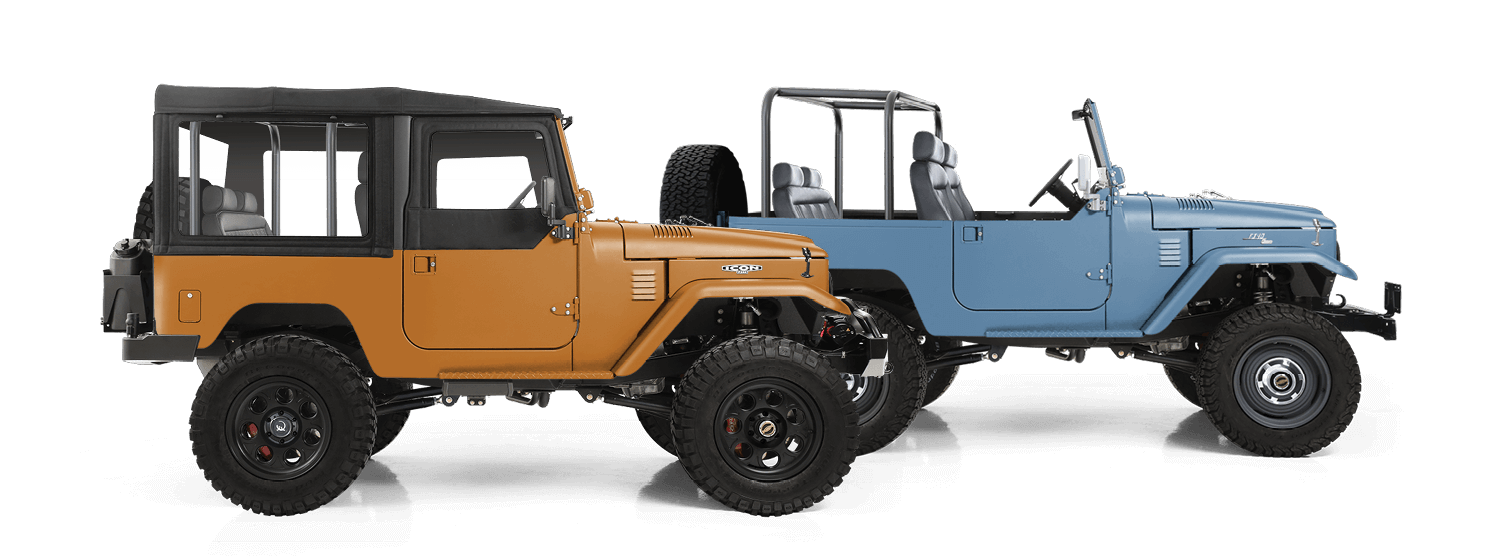
Icon 4x4
Hand-built FJ, Bronco (BR), and Derelict restomods out of Los Angeles, starting well north of $200,000.
Click to learn more →.jpg)
Panoz
Georgia-built front-engine sports cars — Esperante, AIV Roadster, and the Le Mans-winning, street-legal GTR-1.
Click to learn more →
Rezvani
Beast, Tank, Vengeance, Hercules, and RR1 — hand-built American specialty vehicles, capped at roughly 100 units per model.
Click to learn more →
Saleen
From the ground-up S7 supercar to Mustang-based S281 and S302 performance models.
Click to learn more →.jpg)
Shelby
The original 289/427 Cobra and Daytona Coupe through modern CSX continuations and Super Snakes.
Click to learn more →.jpg)
Singer
Reimagined air-cooled Porsche 911s, from Classic Study commissions to the 700+ hp DLS Turbo.
Click to learn more →
SSC North America
From the record-setting Ultimate Aero through today's Tuatara, Striker, and track-only Aggressor.
Click to learn more →
Tesla Roadster
The original 2008–2012 Roadster that launched Tesla, plus the long-awaited new generation.
Click to learn more →
Vector
The W8 and M12 — two of the rarest American supercars ever built, fewer than 35 combined.
Click to learn more →Don't see your American performance brand? Ask us — we cover a wide range beyond what's listed here.
Manufacturer-recognized tuners and independent build houses
A tuned or coachbuilt car isn't just a modified version of the donor vehicle — it's often a different insurable asset entirely, with its own parts sourcing, valuation, and underwriting considerations. This covers officially recognized manufacturer-tuners, independent aero and wide-body specialists, and low-volume British and Middle Eastern performance builders.

Alpina
BMW's officially recognized manufacturer-tuner for over 60 years, building its own numbered, warrantied models.
Click to learn more →_(36981409346).jpg)
Ariel
The exoskeletal Atom and the off-road Nomad — hand-built, minimalist British performance machines.
Click to learn more →
Brabus
Mercedes-Benz's officially recognized manufacturer-tuner, from tuned G-Wagens to the 6x6.
Click to learn more →
Devel
The Sixteen — a Dubai-built, quad-turbo V16 hypercar prototype claiming five-figure horsepower.
Click to learn more →
Liberty Walk
LB-Works wide-body kits transforming Lamborghinis, Ferraris, and Porsches with dramatic aero.
Click to learn more →
Novitec
German tuning house specializing in Ferrari, Lamborghini, McLaren, and Rolls-Royce performance and styling upgrades.
Click to learn more →
RUF
A recognized independent manufacturer in its own right, built on Porsche platforms since the legendary CTR Yellowbird.
Click to learn more →
RWB
Rauh-Welt Begriff — hand-built, one-of-one Porsche 911 wide-body builds out of Japan.
Click to learn more →Don't see your tuner or coachbuilder? Ask us — we cover a wide range beyond what's listed here.
We equally welcome the unique, the rare, the strange, and the one-off
Not every car worth insuring correctly fits neatly into a marque page. If your vehicle is unusual, low-volume, or simply hard to categorize, that's exactly the kind of thing we're built for.
Kit cars & replicas
Faithfully built replicas and kit-car creations, insured on their own terms rather than forced into a category they don't fit.
Concept & prototype vehicles
One-off engineering and design exercises that never reached production — real vehicles that need real, individually underwritten coverage.
Movie, TV & celebrity-owned cars
Vehicles with documented screen or ownership history often carry a premium value that a standard policy has no way to account for.
Grey-market & JDM imports
25-year-rule imports and other grey-market vehicles, including cars that were never officially sold in the US.
Coachbuilt & custom one-offs
Bespoke coachbuilt cars and true one-of-a-kind builds — by definition, there's no comparable-sales data, so valuation has to be built from documentation.
The genuinely strange
If it's unusual enough that you're not sure who else would insure it, that's exactly the kind of call we want.
Vehicles under restoration — and the parts themselves
Coverage for a car mid-restoration looks different from coverage for a finished one — parts in transit, a shop's care-custody-control exposure, and a value that's changing as the build progresses. This extends to the parts inventory itself, not just the assembled car: an engine, a set of body panels, or a garage full of sourced components for a build-in-progress represent real invested value, whether the work is happening at a shop or in your own private garage, and that value can be protected right along with the vehicle.
Restomods & hot rods
A donor car rebuilt around modern engineering, or a traditional hot rod built from the ground up — both represent real, often substantial investment that a standard policy was never built to value.

Restomods: a donor car, rebuilt around modern engineering
Builders like Singer take a donor Porsche 911 and rebuild it almost entirely — modern chassis engineering, a reworked drivetrain, and a completely bespoke interior, wrapped in a body that still reads as a classic 911. The result is a car that's worth substantially more than the sum of its parts, and a standard policy has no framework for pricing that. We build coverage around the actual build sheet and documented investment, not a generic valuation guide.
Photo via Wikimedia Commons (CC BY-SA)
Hot rods: America's original custom-car tradition
A traditional hot rod — a 1932 Ford Deuce coupe is the classic example — represents decades of American custom-car culture, often with thousands of hours and real money invested in fabrication, paint, and drivetrain work. These cars rarely have a comparable-sales market the way a factory-original classic does, which means coverage has to be built around documented parts, labor, and craftsmanship rather than a book value.
Photo via Wikimedia Commons (CC BY-SA)

We cover the vehicle — and the parts, too
If you're working on your own collector vehicle in a private garage, or restoring one in stages over months or years, the parts and components themselves represent real, growing investment long before the car is back on the road — an engine on a stand, a set of body panels, trim and interior pieces waiting to go in. That inventory can be covered right alongside the vehicle, so the value you're building toward is protected at every stage, not just once the project is finished.
A few of the classics that qualify for collector coverage
These five span three decades and two continents — a small sample of the vintage and classic vehicles we help owners insure correctly.
.jpg)
Pontiac GTO
1964–1974
Originally just an option on the Pontiac LeMans, the GTO is widely credited as the car that kicked off the American muscle car era — Pontiac projected 5,000 sales for 1964 and sold more than 32,000. Hagerty values a #2-condition '69 GTO with the 350-hp 350 V8 around $35,300; the rarest Judge Ram Air IV convertibles have sold north of $1.1 million.
Image: Wikimedia Commons, CC BY-SA

1965 Cadillac DeVille / Fleetwood
1965
1965 gave Cadillac's new De Ville series its own convertible and pillared sedan for the first time, on a new perimeter-frame chassis with dual stacked headlamps. Hagerty notes these cars have historically been overlooked next to their finned 1950s predecessors — a coupe in "Excellent" condition averages around $25,000 today, with values expected to keep climbing.
Image: Wikimedia Commons, CC BY-SA
.jpg)
Pontiac Bonneville
1959
The Bonneville became its own model line in 1958, and 1959 brought what's been called one of the most radical year-to-year styling overhauls in Detroit that decade — "Strato-Star" design, lower and longer bodies, split grilles, and twin-fin rear fenders. Collectors generally favor convertibles with a floor-shift manual over the automatic.
Image: Wikimedia Commons, CC BY-SA
.jpg)
Mercedes-Benz 300SL Roadster
1957–1963
Descended from a race car that won the 1952 Carrera Panamericana and the 24 Hours of Le Mans, the 300SL Roadster replaced the famous Gullwing coupe in 1957 — just 249 were built in 1959 alone, out of 1,858 total. Its fuel-injected straight-six made 215 bhp, good for roughly 160 mph, extraordinary for the era.
Image: Wikimedia Commons, CC BY-SA
.jpg)
Bugatti Type 35
1924–1930
Built at Bugatti's Molsheim works, the Type 35 is one of the most successful race cars ever made, with over 1,000 race wins to its name. Values vary enormously by variant and history — Classic.com puts the average sale price around $414,000, with the rarest Type 35B Grand Prix examples selling for more than $5.6 million.
Image: Wikimedia Commons, CC BY-SA
Every vehicle produced before 2002 can qualify for a collector auto policy
It doesn't have to be a Ferrari or a Bugatti. Any make, any model, any body style — if it was built before 2002, it's eligible for consideration under an agreed-value collector policy built around the vehicle's condition, use, and storage, not a standard depreciation schedule.
Tell Us About Your Vehicle
Enter your exact year, make, and model below, along with how to reach you, and an agent will call you with a quote.
Requesting a callback may include a soft credit inquiry used to help provide accurate pricing. A soft inquiry does not affect your credit score and isn't visible to other lenders or creditors. We only collect your name, phone number, and email address here — an agent will gather any additional details by phone.
An independent brokerage, not a single carrier
We're not captive to one insurance company, and we're not a dealership finance office. That independence is the point: our only job is finding you the right coverage at the right price, then advocating for you if you ever need to use it.
Access to multiple carriers
We shop coverage across a range of specialty and standard carriers instead of pricing everything through one company's rate table, so you see real options instead of a single take-it-or-leave-it quote.
Bundle for a better rate
Combine your exotic or collector vehicle with your home, everyday autos, umbrella liability, other collector vehicles, and — where it applies — your business insurance. Carriers price account relationships, and that often means meaningfully better terms across the board.
How much liability coverage is actually enough?
Many people size their liability limits off habit or a state minimum, not off what a real claim costs. A short self-assessment gets you closer to the right number than a guess does.
Net worth, today and soon
Umbrella coverage is generally sized to at least match your net worth, plus a buffer for a few years of future income — a judgment can reach earnings as well as assets. Many umbrella policies start at $1 million and step up from there.
How the car actually gets used
Teen drivers, long commutes, track days, towing, ride-share, or business use all raise the odds and cost of a serious claim, and should push liability limits higher than a car that rarely leaves the garage.
Other liability exposure around your life
Pools, trampolines, dogs, rental property, and hosting large gatherings all add liability exposure that an umbrella policy sits on top of — not just your cars.
What a serious claim actually costs
The average bodily injury liability claim runs roughly $26,500, and severe-injury or multi-vehicle claims run well past that. State minimum limits were set decades ago and haven't kept pace.
Where your auto policy's limit actually stops
If a judgment exceeds your auto liability limit, the difference can come out of your other assets and future income — this is the gap an umbrella policy is built to close.
What you're already bundling
Combining home, auto, and umbrella with one carrier often improves umbrella eligibility and pricing, and is worth asking about regardless of which carrier ends up writing each piece.
Liability & Umbrella Estimator
A quick, educational starting point based on the common "net worth plus income" approach umbrella carriers use. This isn't a quote or personalized advice — just a number to bring into the conversation.
Your estimate
Approximate assets a judgment could reach:
Suggested starting point for umbrella coverage:
Umbrella policies generally require underlying auto liability limits of at least $250,000/$500,000 (or a $300,000+ combined single limit) to attach — worth checking against what you carry now.
Why this matters: in a lawsuit following a serious accident, courts can compel discovery of bank and investment account records to determine what's actually collectible — exposure isn't limited to what your auto policy pays out. Adequate liability and umbrella coverage is what stands between a judgment and wage garnishment or forced liquidation of these assets. This calculator is an educational estimate, not a quote or a substitute for personalized advice — the right number depends on specifics we'd go over together.
| Claim type | Average cost |
|---|---|
| Bodily injury liability claim, all passenger vehicles | ~$26,500 |
Source: Insurance Information Institute, Facts + Statistics: Auto Insurance (iii.org). Figures represent average claim severity and vary by state, injury severity, and number of parties involved.
The line items on your policy that actually matter
A few coverages get bundled into an auto policy without much explanation. Here's what each one actually does.
Uninsured (UM) vs. underinsured (UIM) motorist coverage
UM steps in when the at-fault driver has no insurance at all, or leaves the scene. UIM steps in when they have insurance, but not enough to cover what you're owed. Many states require one or both, and the two are easy to confuse because they solve overlapping problems with different triggers.
Personal injury protection (PIP)
Twelve states require PIP, which pays medical costs — and often lost wages — regardless of fault. Colorado isn't one of them, but it matters if you spend time in, or move to, a state that requires it, or insure a vehicle registered elsewhere.
Medical payments coverage (Med Pay)
Optional in many states and inexpensive to carry, Med Pay pays medical bills for you and your passengers regardless of fault, with no deductible. A reasonable starting point is matching it to your health insurance deductible, so an accident doesn't leave you paying that deductible twice.
Accidental death coverage on an auto policy
A modest, inexpensive add-on — commonly $5,000–$15,000 in benefit — that pays out if a covered accident causes a death. It's not a substitute for life insurance, but it's a low-cost layer worth knowing is available.
The coverages that matter most when something actually goes wrong
These rarely come up until you need them — which is exactly when it's too late to add them.
Loss of use vs. rental reimbursement
Rental reimbursement is coverage on your own policy that pays toward a rental car while yours is repaired after a covered claim, regardless of fault, up to a daily and total cap. Loss of use is different — it's your right to be compensated by an at-fault driver's insurer for the time you're without your car, and it isn't limited to a rental. You can have both, but you can't collect on both for the same loss.
Gap coverage — and early lease turn-in
Gap coverage pays the difference between what you owe on a loan or lease and what the car is actually worth if it's totaled or stolen, which matters most early in a loan or lease with a low down payment. Some policies go further and help with early lease-turn-in charges, which basic gap coverage doesn't always touch.
New car replacement vs. gap coverage
Gap coverage pays your lender or lessor. New car replacement coverage pays you, for a brand-new equivalent vehicle rather than its depreciated value. They solve different problems and are often worth carrying together on a financed or leased vehicle.
What your homeowners policy covers that your auto policy doesn't
If something is stolen out of your car, it's typically your homeowners or renters policy — not your auto policy — that covers the personal property, usually under an off-premises limit worth confirming ahead of time. Your auto policy covers the broken window; your home policy covers what was taken.
Trip delay, interruption, and cancellation are three different things
Trip cancellation covers prepaid costs if you cancel before a trip starts. Trip interruption covers the cost of getting home — plus lost prepaid costs — if a trip is cut short after it begins. Trip delay covers incidental costs like meals or a hotel night when you're stuck somewhere past a period the policy defines. Worth a look any time a car show, auction, or delivery trip involves real travel.
Auto glass isn't just glass anymore
Many current vehicles carry cameras and sensors built into or around the windshield for automatic emergency braking, lane keeping, and adaptive cruise control. Research from the AAA Foundation for Traffic Safety estimates these systems could prevent roughly 40% of crashes, 37% of injuries, and 29% of deaths at full deployment — but only if they're working correctly. A windshield replacement on a car with these systems typically requires a separate recalibration step afterward, and it's worth confirming your policy and repair shop both account for it.
Sources: AAA Foundation for Traffic Safety, research on large-scale deployment of advanced driver assistance systems; Insurance Information Institute; state personal injury protection (PIP) requirements per state department of insurance rules.
A few things that trip people up
These come up less often, but each one can change what you pay or whether you're even eligible for coverage.
A vehicle's own damage history matters, not just yours
Two examples of the same year, make, and model can carry very different insurance costs if one has a branded or salvage title, or documented major prior damage. Carriers underwrite the specific vehicle, not just the driver — a rebuilt or previously damaged car often costs more to insure, or is limited to actual-cash-value coverage rather than full comprehensive and collision.
SR-22 — what it actually is
An SR-22 isn't a type of insurance; it's a certificate your insurer files with the state confirming you carry the minimum required liability coverage. States typically require one after a DUI, a suspended license, an at-fault accident without insurance, or too many violations, generally for about three years. We write SR-22 policies and handle the state filing directly.
International driver's licenses
Holding a foreign license or international driving permit doesn't rule out US coverage. We write policies for drivers on a valid foreign license or IDP, using the documentation carriers require — typically the license itself, a passport, and proof of state residency.
Get your exotic or collector vehicle covered correctly
Tell us about your car — make, model, year, how you use it, and anything else worth knowing — and we'll put together coverage shopped across multiple carriers.